
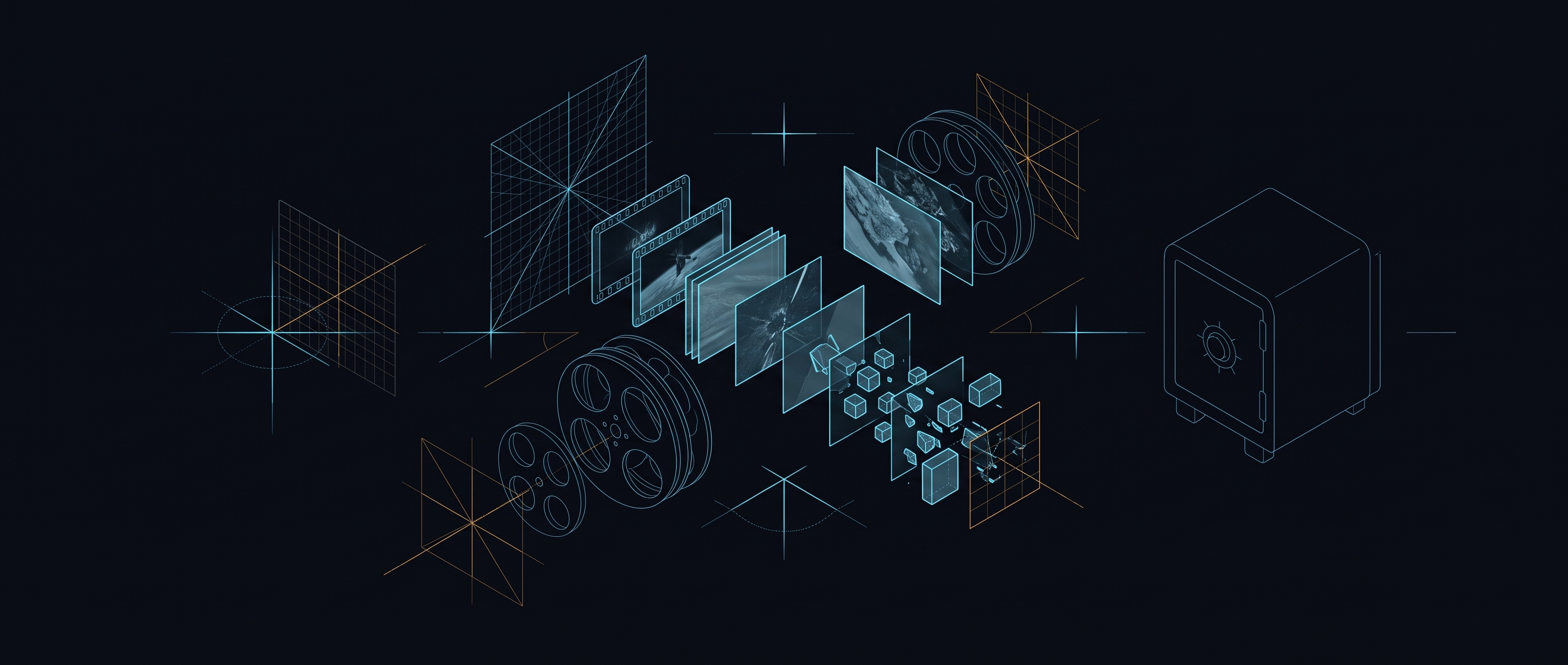
Those processing high-resolution image stacks or extensive video recordings of astronomical and macroscopic subjects quickly encounter the limitations of conventional stacking suites. When thousands of uncompressed RAW frames or 4K video streams flood the RAM, conventional programs fail with memory fragmentation, creeping memory leaks, or fatal Out-of-Memory (OOM) crashes.
The MoonEngine, in conjunction with the cognitive subsystem L.U.N.A. Prime, follows a fundamentally different philosophy: Resource Efficiency as a Design Principle. Software should not assume that workstations equipped with 128 GB of RAM and high-performance GPUs are available. Instead, the algorithms are designed to achieve deterministic peak performance even on older systems or office PCs with limited memory.
1. Zero-Memory-Leak & Chunk Streaming: The PredictiveCache
The core problem in classical image processing lies in the naive loading of complete datasets into RAM. With 10,000 frames from a seeing video or a macro focus series in the 16-bit color space, the memory requirement grows exponentially into the hundreds of gigabytes.
The MoonEngine breaks this paradigm through a strictly decoupled streaming pipeline:
- Deterministic Chunking: Image series and film sequences are never decompressed as a whole but are divided into dynamic time windows (Chunks).
- Active Garbage Collection & Scope Isolation: As soon as a frame has been processed, transformed, or evaluated, the matrix is explicitly released, and the Python memory manager is cleaned via hard scopes.
- PredictiveCache: Instead of holding raw images, the cache stores only compressed sharpness and edge matrices, as well as transformation vectors.
Even with 10,000 source frames, the RAM footprint remains on a constant plateau.
2. Agent Joan: Intelligent Film Decomposition & Lucky Frame Extraction
In planetary astrophotography and extreme macro photography, video recordings (such as SER or MP4 files) are standard for capturing the rare milliseconds of perfect atmospheric stability. But how do you filter the sharpest 5 to 10 percent out of 10,000 shaky frames without overheating the CPU?
This is where Agent Joan (AgentJoanExtractor) takes over autonomous direction:
Agent Joan's Operation
- Real-time Hardware Audit: Before a single frame is read, Joan determines the actual free RAM using
psutiland consults the Safety Watchdog (AgentOtho). A system with 8 GB of RAM is automatically assigned fewer parallel workers than a workstation to rigorously prevent disk swapping. - FFmpeg Sector Decomposition: Joan virtually splits the source video into equally sized segments and extracts frames highly in parallel via lightweight pipes directly into temporary workspace directories.
- Float32 Variance of the Laplace Operator: Each frame is converted to grayscale and analyzed using an optimized Laplace kernel:
- Heap-based Selection (Lucky Frames): Instead of keeping all images in memory, a Min-Heap procedure immediately discards unusable, blurry frames. Only the absolute quality peaks are moved to the target archive; temporary chunks are completely purged.
3. Agent Greg: The Archivist and Visual Memory
A stack is only complete once the acquired data has been structurally cataloged. This is where Agent Greg (AgentGreg) comes into play. He functions as the librarian and knowledge manager of the MoonEngine.
3. Agent Greg: The Archivist and Visual Memory
A stack is only considered complete once the acquired data has been structured and cataloged. This is where Agent Greg (AgentGreg) comes into play. He functions as the librarian and knowledge manager of the MoonEngine.
# Excerpt from agents/agent_greg_archivist.py:
# Concurrency-safe cataloging with WAL mode
def _get_connection(self) -> sqlite3.Connection:
 conn = sqlite3.connect(self.db_path, timeout=10.0)
 conn.execute("PRAGMA journal_mode=WAL;")
 return conn
Agent Greg does not simply save image files to the disk. He utilizes a persistent SQLite database in Write-Ahead Logging (WAL) mode, which can be served by multiple agents in parallel without file locking:
- Telemetry Tracking: For every computational run, hardware specifications, run times, frame yield, and achieved sharpness values are logged granularly.
- Visual Memory (
visual_memory): Using cryptographic checksums (MD5), Greg identifies image characteristics and links them to metadata. - 3D Upgrades of Old Missions: If Greg discovers historical 2D surface images from previous runs, he triggers the
TacticalMapperin the background to calculate topographic height profiles and 3D maps from them.
4. How L.U.N.A. Learns from the Data
L.U.N.A. Prime is not a rigid image processor but an adaptive organism. The system does not process image series as a disposable product; rather, it utilizes the feedback from Agent Greg's telemetry and memory tables for a closed learning loop:
- Dynamic Parameter Adjustment: If edge reconstructions fail for a specific object type (e.g., mineral specular highlights or strongly diffuse edge seeing), L.U.N.A. compares the current measurements against historical mission data. The thresholds for Laplace normalization are then corrected a priori for the next iteration.
- Hardware Prediction: From the telemetry data of Agent Joan, L.U.N.A. learns which chunk sizes on the respective host computer yield the highest processing speed per watt. The system autonomously calibrates its multithreading load.
- Semantic Pattern Recognition: By storing successful sharpness indices, L.U.N.A. builds an internal understanding of which frequencies in the image represent actual surface structures (e.g., lunar craters or spore capsules) and which components are merely high-frequency sensor noise.
Conclusion: Cognitive Image Fusion over Brute Force
By combining Agent Joan's hardware-adaptive Lucky-Frame filtering, Agent Greg's robust WAL archiving, and the strict Zero-Memory-Leak strategy, the MoonEngine proves that outstanding image processing is not merely a matter of raw computational power.
Through intelligent scheduling and adaptive heuristics, L.U.N.A. Prime makes professional image reconstruction accessible to everyone—reproducible, highly performant, and resource-efficient.