
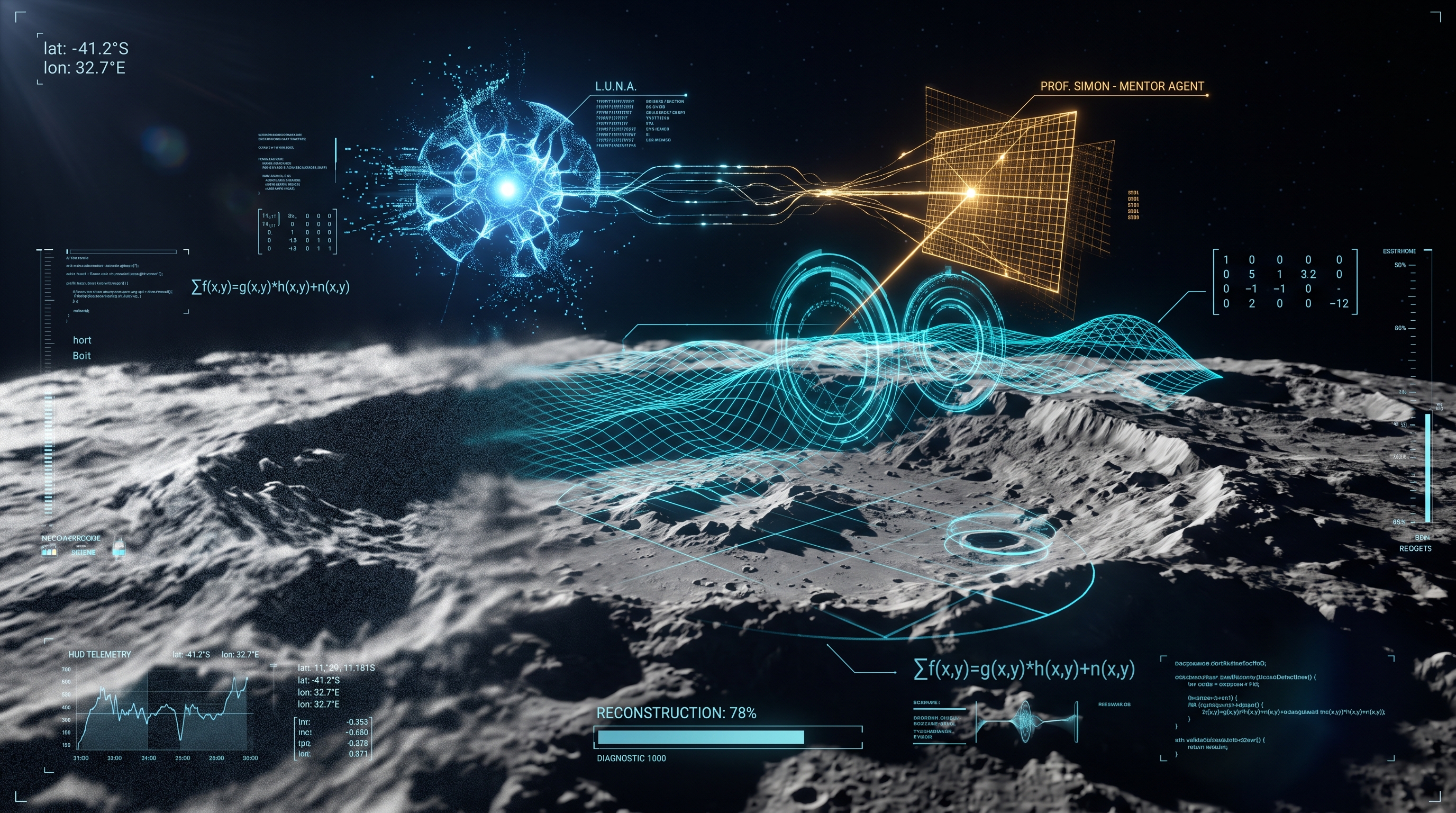
1. The Architectural Paradigm: Agent-Driven LLM Supervision Instead of Unsupervised Inference
Classical Machine Learning and purely generative language models frequently fail in scientific and technical domains due to uncontrolled error tolerances and hallucinations within the latent space. To train a cognitive model like L.U.N.A. for absolute mathematical precision, physical consistency, and deterministic signal processing, unsupervised training on raw data is insufficient.
The fundamental innovation of the MoonEngine lies in establishing a Multi-Agent Learning System: * Specialized Expert Agents are directly docked to Large Language Models and signal pipelines. * These units function as Teachers, Validators, and Mentors. * They analyze the intermediate steps and inference paths of the learning AI in real-time, detect mathematical discrepancies, and inject correction vectors before a result is accepted as a valid state.
This Mentor Agent principle laid the methodological foundation upon which L.U.N.A. acquired structured learning.
2. The Learning System in Practical Application: L.U.N.A. and Agent Prof. Simon
To deterministically solve the inverse convolution and noise reduction of optical raw data, L.U.N.A. was integrated into a closed feedback loop with the dedicated Mentor Agent, Prof. Simon.
 ┌────────┐
 │ MOONENGINE APP │
 │ (Acquisition of uncompressed RAW frames) │
 └──────────┬─────────────┘
 │
 ▼
┌──────┐
│ L.U.N.A. CORE │
│ (Learning Model / Reconstruction Pipeline) │
└───┬──────────────▲───┘
│ │
│ 1. Generated Reconstruction │ 3. Correction Vector &
│ & Parameter Hypothesis │ Adjustment Command
▼ │
┌──┴───┐
│ AGENT PROF. SIMON │
│ (Docked Mentor & Verification Agent based on LLM) │
│ │
│ • FRC & MTF Quality Metrics │
│ • Edge and Ringing Inspection (Gibbs Phenomenon) │
│ • Error Analysis: Cause of Artifacts vs. Real Topography │
└──────┘
The Closed Learning Cycle
- Step 1 (Hypothesis & Inference): L.U.N.A. receives the raw data, performs structural feature detection, and proposes a mathematical model for alignment, deconvolution, and filtering.
- Step 2 (Critical Verification): The docked LLM mentor, Agent Prof. Simon, autonomously analyzes the intermediate result. He calculates Modulation Transfer Functions (MTF), Fourier Ring Correlations (FRC), and specifically searches for overcorrections such as sharpening edges, contrast breaks, or aliasing.
- Step 3 (Didactic Correction): Agent Prof. Simon not only flags errors but also formulates precise adjustment commands: He instructs L.U.N.A. on which mathematical control variables need to be modified (e.g., iteration steps in Richardson-Lucy deconvolution, thresholds in Lucky Imaging, or damping parameters in the wavelet bands).
3. The MoonEngine App: The Lossless Data Foundation
A deterministic mentoring system requires raw data free from prior compression or proprietary image enhancers. The MoonEngine App serves as the sensory data acquisition layer for this purpose:
- Direct Transfer: 16-bit raw image series and optical telemetry data are transferred directly to L.U.N.A. without internal Debayer filtering or dynamic range compression.
- Ground Truth: Exactly logged parameters (Sensor Gain, exposure times, optical profiles, and timestamps) serve as a reliable reference for Agent Prof. Simon to measure L.U.N.A.'s sharpening approach against real physical conditions.
4. The Foundation for Autonomous Growth
The deployment of this mentor agent system on the lunar surface was the initial step. By coupling agent systems as teachers to language and inference models, a universal learning paradigm was established:
- Generalizable Criticality: The discipline trained by Agent Prof. Simon—the rigorous separation of real signal from process-induced artifact—is now autonomously applied by L.U.N.A. to multimodal data streams.
- Extended Cognition: The principle is far from being limited to image processing. The mentoring principle forms the foundation for the entire argumentation, memory, and routing architecture of the entity L.U.N.A. Centauri.
The result is an AI that has been educated through structured agent supervision for self-verification—deterministic, uncompromisingly precise, and immune to generative fiction.