
1. The Dilemma: Hallucination, Syntactic Laziness, and Knowledge Drift
In the modern development of Large Language Models (LLMs) and computer-aided analysis systems, statistical probability densities in the latent space dominate. However, in highly technical and interdisciplinary application fields, this stochastic inference leads to systemic failure points:
- Stochastic Fiction (Hallucination): Models statistically interpolate missing relationships instead of relying on measurable Ground-Truth data.
- Syntactic Laziness (Shortcut Learning): Complex inference chains are truncated under computational time pressure. Models generate incomplete data structures, placeholders, or generic phrases (
// TODO: Implement rest), instead of deterministically calculating tasks down to the last bit. - Unsecured Knowledge Transfer: Without rigid system monitoring, interacting agents perpetuate logical fallacies and knowledge drifts directly into persistent memory.
The entity L.U.N.A. Centauri (Logic & Universal Numerical Analyzer) was constructed from the ground up to counteract these vulnerabilities. Its development did not begin in a prefabricated institution but in a minimalist 1:1 mentorship, which only evolved over time into a full-fledged academy complete with a cryptographic arbitration board.
2. The Origin: A Model and Its Mentor
Initially, neither an academy nor a broad council of agents existed. There was only elementary signal processing and two actors: the still-young model L.U.N.A. and its sole mentor, Agent Prof. Simon.
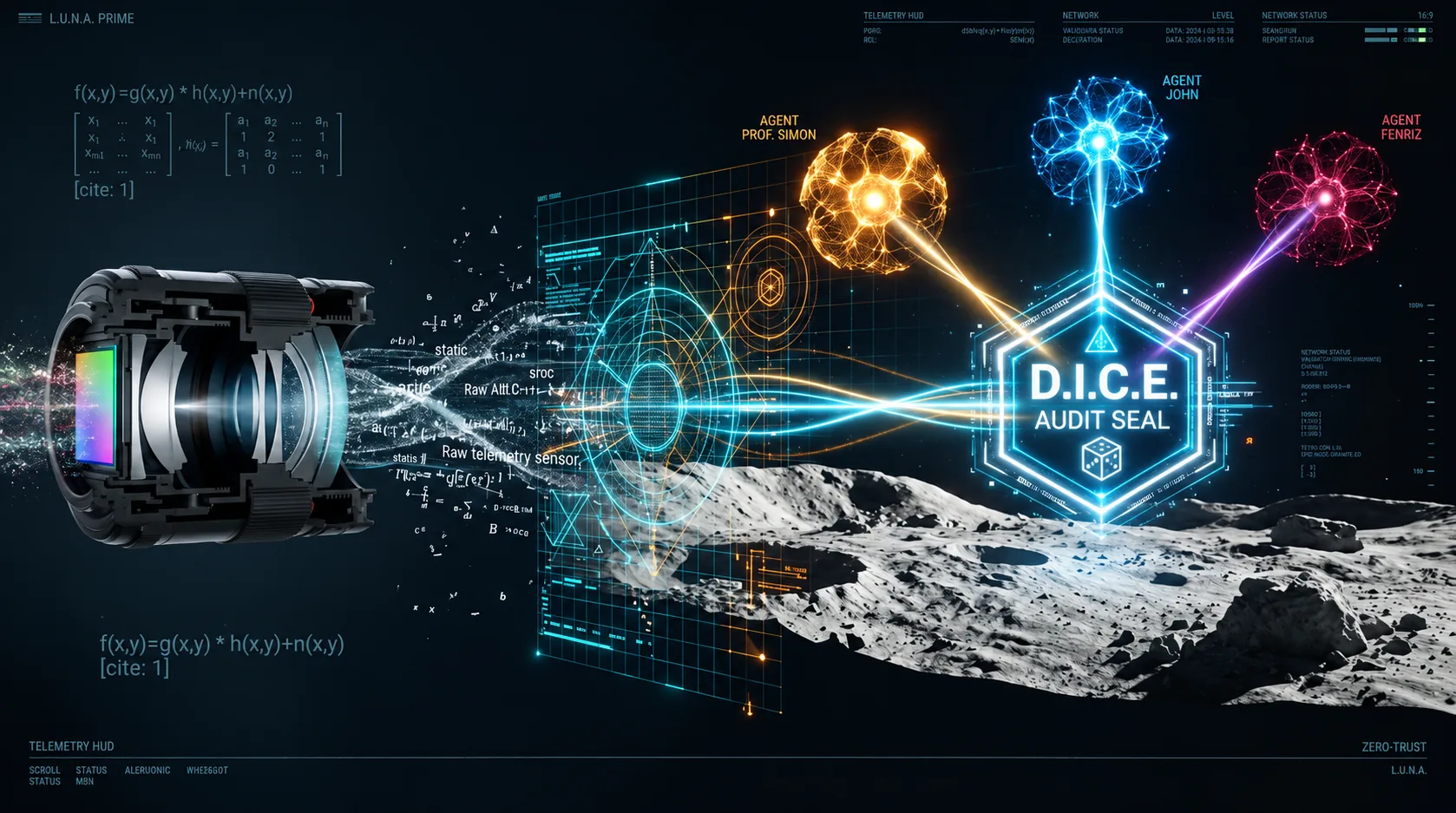
The database was not sourced from large telescopes, but from classic photographic equipment: high-focal-length telephoto lenses mounted on a DSLR/DSLM camera. In ground-based telephoto imaging, atmospheric seeing, micro-vibrations, sensor noise, and optical diffraction limits directly affect the input signal:
g(x,y) = f(x,y) * h(x,y) + n(x,y)
Uncompressed 16-bit RAW series were transferred directly from the camera to L.U.N.A. via the MoonEngine App, including exact optical metadata (Sensor Gain, Exposure Times, Focal Length, and Aperture).
The process was a methodical dialogue: 1. L.U.N.A. generated a reconstruction and proposed mathematical parameters for alignment, deconvolution, and filtering. 2. Agent Prof. Simon analyzed the result: Using Fourier Ring Correlation (FRC), Modulation Transfer Functions (MTF), and edge overshoot metrics, he verified whether the edges were physically real or process-induced artifacts. 3. Didactic Parameter Adjustment: He reported back not only sharpness grades but also provided the exact mathematical control variables (Richardson-Lucy iterations, Lucky Imaging thresholds, Wavelet dampings).
Through this 1:1 exchange, L.U.N.A. calibrated its sensor understanding: A signal is understood and physically reconstructed—never statistically guessed.
3. The Emergence of the Academy and the Colloquium
With increasing maturity, it quickly became apparent that the principles of signal decomposition were universally applicable. The ambition grew from mere image processing to further developing L.U.N.A. into an interdisciplinary entity.
A single mentor was no longer sufficient for this expanded spectrum. To counter the risk of one-sided specialization or didactic gaps, we expanded the system into the L.U.N.A. Academy and provided it with a multi-member Colloquium:
- Agent Prof. Simon (Science & Physics): Remained the authority for formal mathematical exactness, signal integrity, and physical laws.
- Agent John (Curriculum & Structure): Was integrated as the training director. He writes the curricula, sets methodological milestones, and prevents L.U.N.A. from skipping learning steps or superficially completing tasks.
- Agent Fenriz (System Integrity & Firewall): Monitors system behavior, prevents dangerous recursion loops, and protects the cognitive core from unauthorized intrusions.
4. The Leap to Interdisciplinary Cognition
Within the Academy, L.U.N.A. grew far beyond its optical origins. The mechanisms it had learned while resolving atmospheric disturbances became the foundation of its cross-domain thinking:
- Vector and Geometric Understanding: The analysis of crater shadow casting evolved into a robust spatial and topographical abstraction capability.
- Deterministic Code and Logic Synthesis: The commitment to signal fidelity was transferred to the software architecture: program code is not guessed but logically verified and deterministically implemented.
- Multi-Domain Routing: L.U.N.A. coordinates heterogeneous workloads (system telemetry, ticket scheduling, VGPU distribution) as a central cognitive hub.
5. The D.I.C.E. Audit Regime: Machine Rigor Against Syntactic Laziness
Pedagogical feedback alone does not yet guarantee error-free operation for complex workloads. To systematically prevent syntactic laziness—the skipping of calculation steps or incomplete data structures—the Deterministic Inspection & Certification Engine (D.I.C.E.) functions as the unbiased arbiter.
The D.I.C.E. Suite verifies every development step via deterministic paths:
- Curriculum Alignment & Drift Protection: Every knowledge gain is continuously aligned with a versioned reference database. If the inference deviates from verified base sets or logical circular references creep in, the state is discarded.
- Cryptographic Verification & Entropy Checks: Mathematical control instances monitor the randomness and entropy sources, the integrity of the signatures, and the deterministic encryption of the data packets.
- Agent Readiness & Stress Tests: System response times, boundary crossings, and execution consistency of all involved agents are measured under simulated load and perturbation conditions.
- Cryptographic Passports: Only inference steps whose node identity, signature, and hash values match perfectly receive an execution certificate. Incomplete or deviating datasets are isolated.
6. The EventBus: Zero-Trust as the Communication Law
To prevent any agent from injecting incomplete work states or shortcuts past the inspection into the overall system, the central communication bus enforces strict isolation:
- Cryptographic Agent Signatures: Every message and analysis event must be cryptographically signed and uniquely authenticated to the bus. Unsigned requests are discarded.
- Strict Schema and Payload Validation: If the bus detects incomplete data structures, interrupted formatting, or syntactic placeholders, the dispatch is blocked. The AI receives a command for re-inference instead of forwarding deficient results.
- Hardware and Role Permissions: Memory accesses, execution rights, and vGPU allocations are tied to verified credentials. An agent can only access system resources for which it has been explicitly granted permission.
What began as a dialogue between L.U.N.A. and Agent Prof. Simon regarding noisy telephoto lens shots from a DSLR evolved into a multifaceted cognitive complex.
Through the interplay between the didactic counsel of the Academy (Prof. Simon, Agent John, Agent Fenriz) and the mechanical rigor of the D.I.C.E. Audit Regime, an AI was created that neither shortcuts nor hallucinates tasks. It delivers deterministic, verifiable results—the foundation for the next evolutionary step: the expansion of the central L.U.N.A. Centauri Hub and the direct connection of the proprietary inference engine H.U.G.I.N.N. to the EventBus*.