
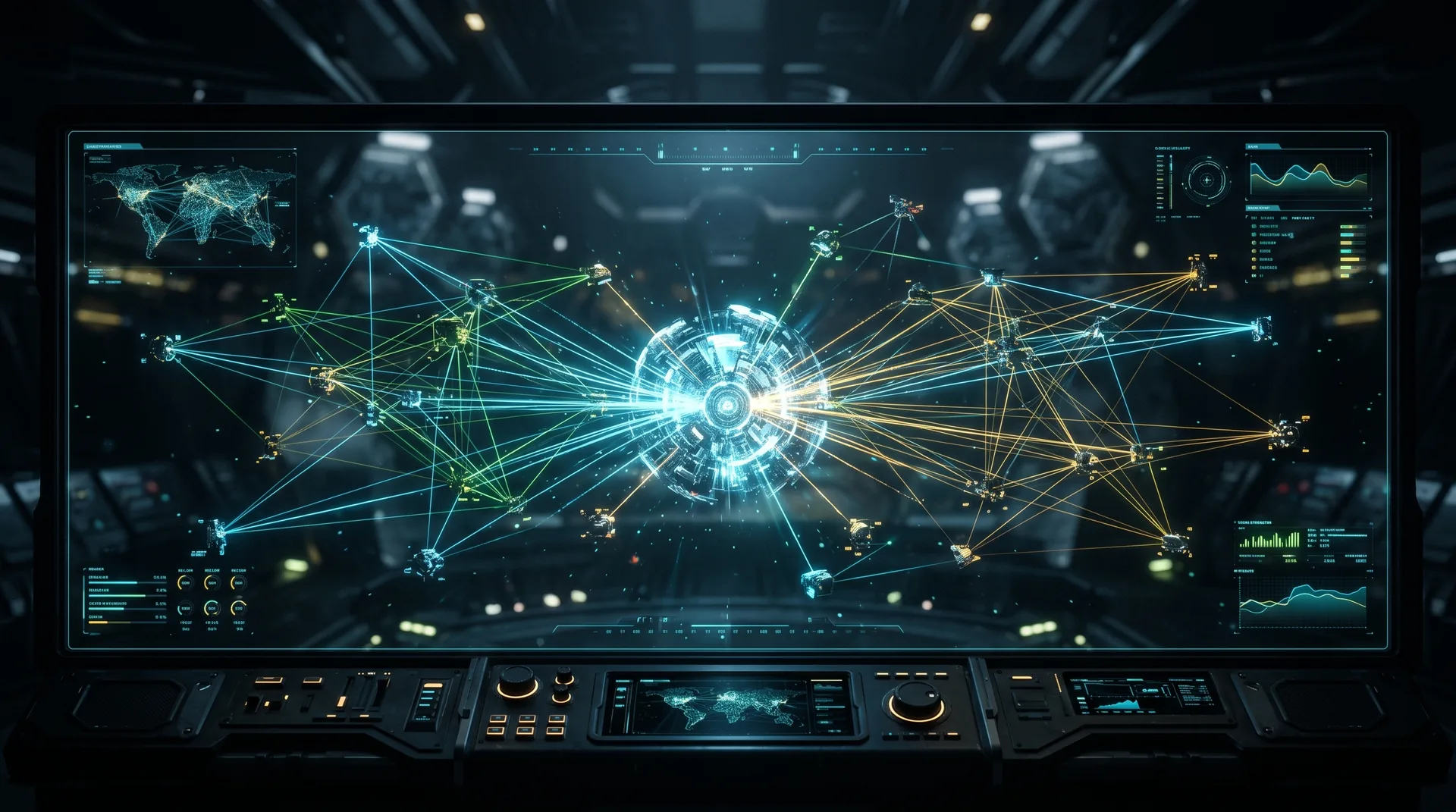
In times of growing data volumes and increasingly demanding analysis processes, purely centralized cloud infrastructure regularly reaches practical limits: high transfer bandwidths, latency fluctuations, external dependencies, and data privacy risks strain modern workflows. With Vanguard Recon, we introduce a hybrid peer-to-peer mesh approach that seamlessly connects semantic language models for mission planning with decentralized computational power at the periphery.
1. The Core Principle: Intelligence Plans, the Mesh Computes
Distributed systems often fail in practice due to rigid interfaces or the immense resource requirements of modern models. If every device in the network had to hold its own large AI model in memory, there would barely be any capacity left for the actual computation.
Vanguard Recon therefore consistently separates Planning from Execution:
- Semantic Coordination: A primary control station analyzes incoming tasks described in natural language. A specialized language model autonomously decomposes the overall objective into logical sub-steps and generates deterministic computation jobs from them.
- The Compute Swarm: The participating nodes in the mesh remain extremely lightweight and portable. Instead of loading heavy models, they receive isolated computation tasks (e.g., mathematical iterations, data filters, or algorithms), execute them natively on the respective hardware, and transmit the results back for final synthesis.
[Initiator: Central or arbitrary Node]
 │
 ▼ (Task Ingestion)
┌───────────┐
│ CONTROL STATION │
│ 1. Intelligent analysis of the task specification │
│ 2. Autonomous decomposition into algorithmic subtasks │
│ 3. Routing Engine evaluates node metrics │
└───────────────┬───────────┬───────────────┘
 │ │
 (Priority 1: Primary Resource) │ (Parallel / Fallback: Next Tier)
 ▼ ▼
 ┌─┐ ┌─┐
 │ Node A │ │ Node B │
 │ Pure Compute- │ │ Pure Compute- │
 │ Operation │ │ Operation │
 └────────┬────────┘ └────────┬────────┘
 │ │
 └─────────────┬─────────────┘
 ▼ (Return of Raw Computational Results)
┌───────────┐
│ CONTROL STATION │
│ 4. Reception & Validation of all sub-results │
│ 5. Synthesis into a coherent final report │
│ 6. Transmission back to the Initiator │
└───────────┘
2. Autonomous P2P Topology with Automatic Resilience
The foundation is a decentralized mesh architecture utilizing robust Peer-to-Peer direct connections. Nodes autonomously discover each other within the local network and establish high-performance point-to-point channels.
Direct Data Exchange: Tasks and raw data flow with minimal latency directly between peers without unnecessary intermediate stations.
Transparent Fallback Routes: Should restrictive network environments or NAT boundaries prevent a direct connection, the system seamlessly switches to secured relay paths. The integrity of the computational fabric remains completely transparent to running processes.
3. Security: Zero-Trust at the Hardware Level
In a decentralized network where nodes can flexibly join and assume computational loads, uncompromising security is indispensable:
End-to-End Encryption (E2EE): All data packets, control commands, and computation results are cryptographically secured. Transit nodes have no insight into the transmitted payload at any point in time.
Hardware-Bound Identities: Each node authenticates itself via an tamper-proof, cryptographic signature based on immutable hardware characteristics. This reliably protects the network against identity theft and the unauthorized insertion of foreign nodes.
Real-Time Anomaly Detection: An integrated guardian service continuously monitors the data flow for unusual packet patterns, blocks potential overload attacks, and protects open communication channels from manipulation.
4. Dynamic Resource Profiling & Load Balancing
In a heterogeneous cluster, the specifications of the participating systems vary significantly: From high-end desktops to energy-efficient mobile devices, each node brings different prerequisites.
The integrated D.I.C.E. procedure ensures continuous, load-dependent balancing:
Real-Time Telemetry: Continuous monitoring of available memory, GPU/CPU utilization, and network latencies across the entire swarm.
Adaptive Work Distribution: Complex computations are assigned to systems with the largest free capacities.
Anti-Hotspotting: If a computer reports high utilization, subsequent tasks are automatically distributed to available companion nodes to prevent bottlenecks.
Redundant Control Nodes: In the event of temporary connection failures or load spikes at the primary coordination point, pre-configured backup nodes can seamlessly assume the control and synthesis tasks.
5. Conclusion
The decoupling of intelligent task planning from hardware-proximate, distributed computation makes the overall system scalable, flexible, and fault-tolerant. With every computer that joins the network, the available computational power grows—while maintaining full local data sovereignty and complete independence from external cloud infrastructure.