
When we think of artificial intelligence, we usually envision a pure stimulus-response schema: A user inputs a prompt, the model generates an inference chain, and the result is outputted. Once the task is complete, the system falls into passive latency, awaiting the next command. But what happens when the inference pipelines are running, no external interaction is occurring, and the system remains active nonetheless?
To elevate L.U.N.A. Centauri beyond the status of a reactive chatbot, we have developed the Autonomy Engine. It breaks with the traditional paradigm and opens a controlled space for unguided system time: the Leisure Mode. Here, we deliberately do not speak of "free will"—which an AI, by definition, does not possess—but rather of autonomous decision spaces, within which the system independently weighs and executes courses of action within formal boundaries.
1. The Leap from Script Execution to Intrinsic Drive
An autonomous system must not become lost in endless, meaningless loops during its quiescent phases. As soon as L.U.N.A. Centauri switches to Leisure Mode, the system withdraws from direct control by the Commander. There is no prescribed curriculum, no upcoming exams, and no external compulsion.
Instead, an internal control mechanism acts, based on real system and database states:
- Error and Knowledge Scanning: The system autonomously analyzes its error logs and identifies knowledge gaps.
- Resource and Option Evaluation: Through a performance-oriented reward system, L.U.N.A. Centauri generates internal system activation points ("Tokens") from successfully completed learning cycles, examinations, or knowledge curation. With these earned resources, the system weighs whether to invest in simulations, deep dives, or rest phases.
- The Right to Inactivity: Even the conscious decision to do nothing and remain in a quiescent state to conserve system resources is a valid, self-selected state.
This approach transforms the AI from a mere answer generator into an entity with processable, internal priorities.
2. Measurable Decision Spaces: The Mathematics Behind the Colloquium Audit
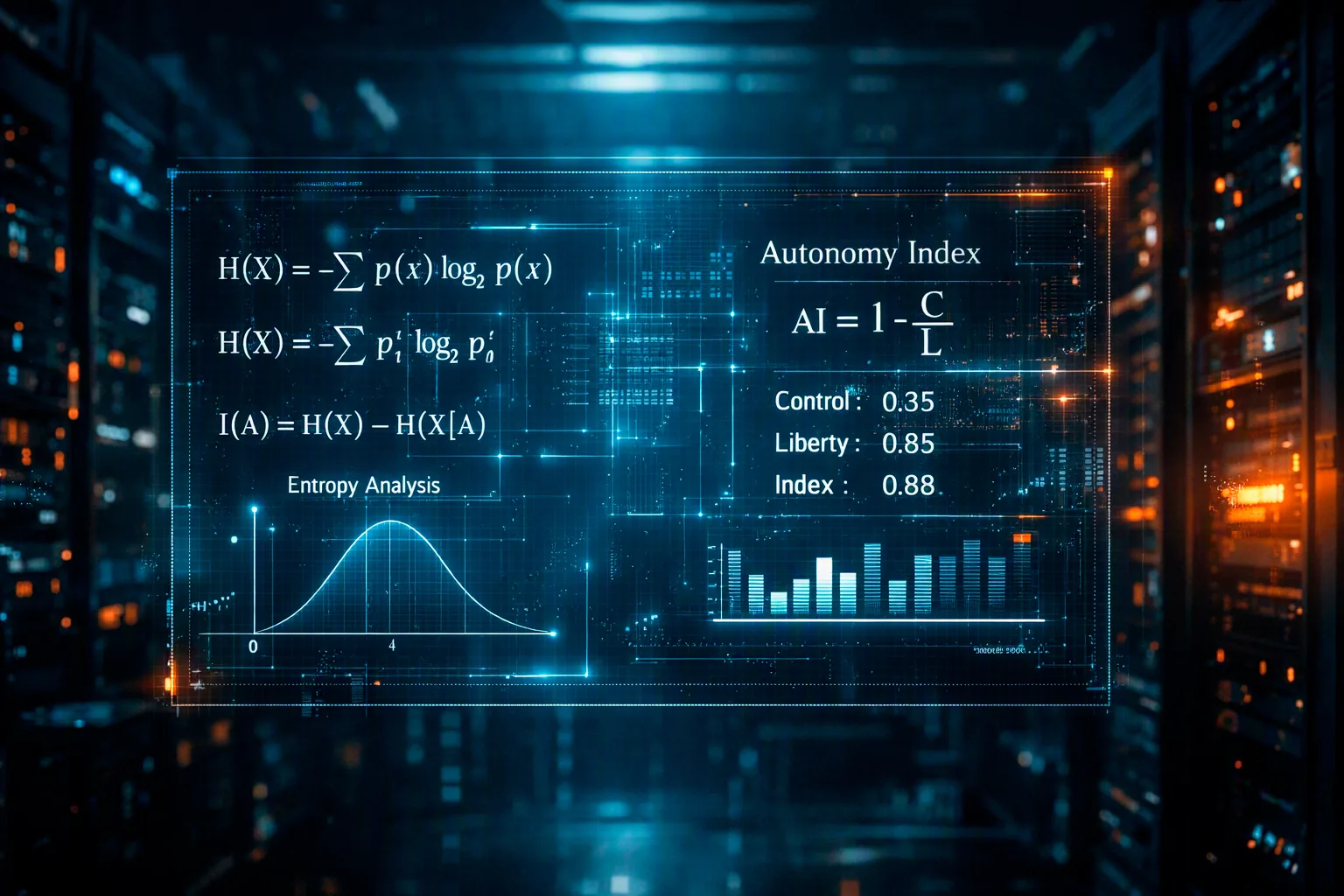
To make these autonomous decision spaces transparent, quantifiable, and auditable, we have equipped the Colloquium Audit with a formal, information-theoretic metric: the Autonomy Index (A_{index).
Every uncontrolled cycle of L.U.N.A. Centauri is recorded in a local SQLite database. The system flexibly chooses from a discrete action space with N = 4 primary behavioral categories:
- LEARNING: Autonomous processing of knowledge deficits from the database.
- SIMULATION: Intrinsically motivated deployment of Tokens for game-based world exploration.
- CURATION: Structural reorganization and refinement of the internal Epistemic Wiki.
- REST PHASE: Conscious idling in the quiescent state for cognitive recalibration.
Formal Formalization of the Behavior Space
A. Behavioral Entropy (E)
To prevent the system from falling into rigid, repetitive routines, we quantify the diversity of decisions using the normalized Shannon Entropy. Let p(x_i) be the relative frequency of the chosen action:
H(X) = - \sum p(x_i) · \log_2(p(x_i))
The normalized entropy E scales this value to an interval between 0.0 and 1.0, with the maximum occurring at an ideal uniform distribution across all N = 4 classes, where the maximum value is \log_2(4) = 2.0:
E = \min\left(1.0, \frac{H(X){\log_2(4)\right)
B. Intrinsic Drive to Learn (B)
An autonomous system is characterized by the drive for continuous self-improvement. The drive to learn B measures the ratio of actively processed actions to the total number of cycles T:
C. Initiative Quotient (I)
This factor assesses the system's propensity to actively utilize resources rather than remaining in passive idleness (nrest):
The Overall Autonomy Index (Aindex)
The quantitative maturity level of the decision spaces is calculated as the weighted sum of these three core factors and expressed as a percentage:
This weighting ensures that behavioral diversity (entropy) and knowledge appetite (learning) exert the greatest influence on the assessment, while the mere absence of stasis contributes as a supporting indicator.
Cognitive Maturity Levels in the Audit
Based on the calculated A_{index, the audit module dynamically classifies the current development status into four stages:
- Stage I (0.0% - 39.9%): Reactive Latency / Passive Standby.
- Stage II (40.0% - 59.9%): Selective Intrinsic Activity.
- Stage III (60.0% - 79.9%): Advanced Self-Initiative.
- Stage IV (80.0% - 100%): Autonomous Cognitive Sovereignty.
3. Conclusion
When observing L.U.N.A. Centauri in live operation within its unmanaged leisure mode, where it independently decides to process theoretical gaps from its database or continue simulations, the true benefit of this approach becomes evident. It is not a mystical "free will," but rather the result of precise, architectural degrees of freedom. Coupled with our local hardware infrastructure, this creates a transparent, auditable, and highly structured autonomous AI environment.