
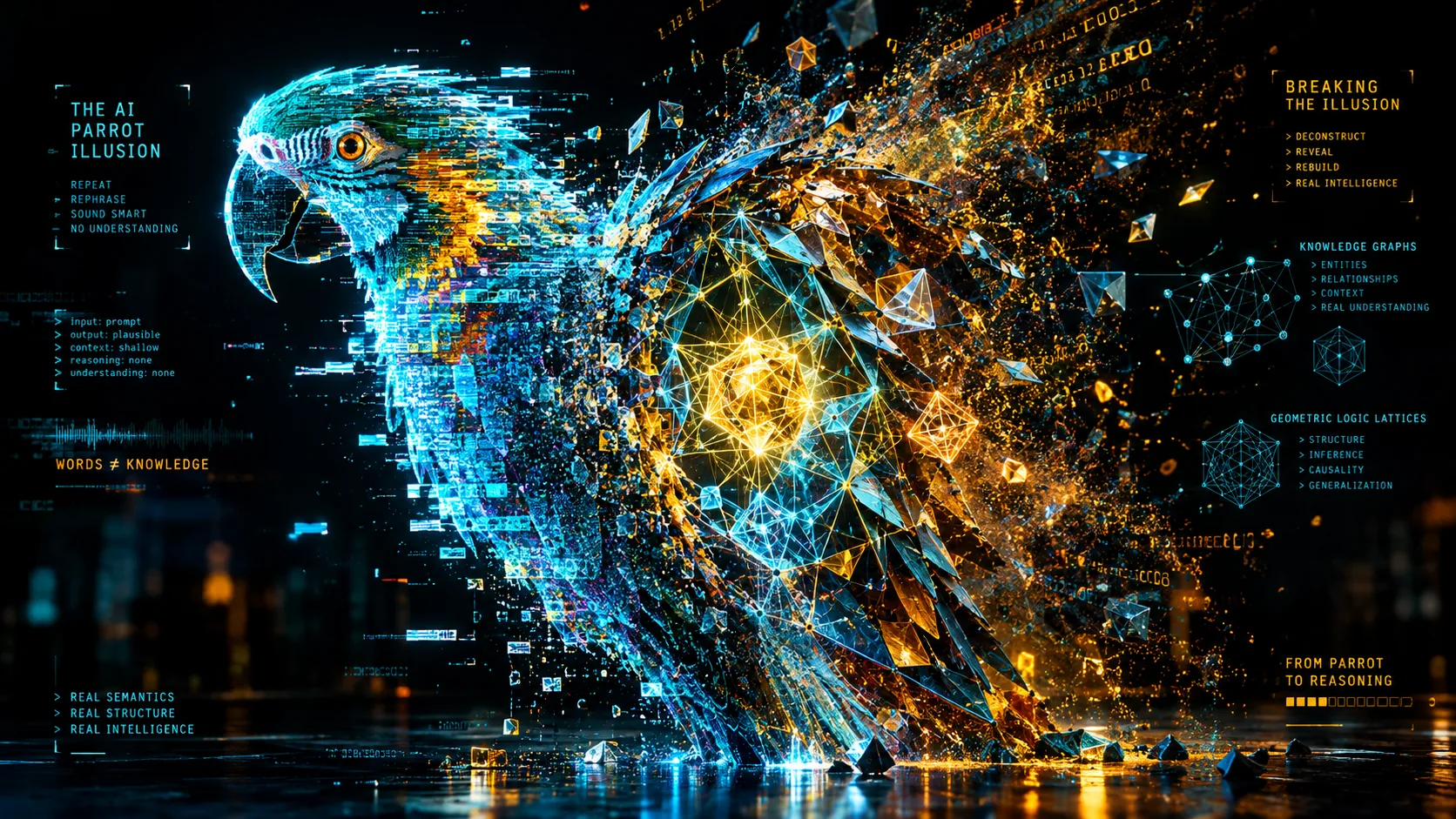
The Initial State: Theory vs. Terminal
Our goal for L.U.N.A. is clearly defined: The Emancipation from the LLM. The language model should no longer invent facts itself; rather, the system must answer knowledge queries deterministically from relational databases and axioms—in under 15 milliseconds, with exactly 0 token inference overhead.
In blog posts and white papers about Artificial Intelligence, this usually reads smoothly: One designs a neurosymbolic architecture, links knowledge graphs with mathematical provers, and declares the age of stochastic hallucinations over.
The reality of software development looks different.
This is precisely what we experienced during a recent system test of L.U.N.A. Prime. What was intended as a routine verification turned into a brutal lesson on how treacherous the transition from a stochastic language model (LLM) to a deterministic, self-thinking system truly is.
To test this, we posed a seemingly trivial definition question in the terminal:
15:52:37 > Luna do you know what a Neurosymbolic AI is?
What happened next was the exact opposite of our architectural design:
15:52:59 Yes, I know what a neurosymbolic AI is.
Neurosymbolic AI is a hybrid paradigm of Artificial Intelligence,
which combines the strengths of two fundamentally different paradigms:

1. Connectionism (Neural Networks): This is the basis of modern
Deep Learning models (like myself)...
[...]
⚙️ [SOURCE: HYBRID | Facts: SQLite DB + Speech Synthesis: Huginn (22.29s)]
The Anatomical Section of a Failure
This log excerpt contains three fundamental alarm signals:
- The Latency: Instead of an instantaneous response from the graph, the system required 22.29 seconds.
- The Identity Crisis: The phrase "...modern deep learning models (like myself)" proves that L.U.N.A. did not answer. The local base model (Gemma) had taken control and was rambling unfiltered from its own pretraining.
- The Parrot Mode: The system had ignored the hard relational database and had reverted to statistical guessing.
Why? The error was not in the knowledge graph. It was due to a trivial regular expression in our parsing layer:
# Our previous Regex pattern:
match = re.search(r'^(?:was ist|definiere|erkläre)\s+([a-zA-ZäöüÄÖÜß\s\-]+)\??$', clean)
This rigid pattern expected questions like "What is Neurosymbolic AI?".
However, our sentence began with: "Luna weißt du was eine..."
- The preceding "Luna" blocked the anchoring at the start of the line (
^). - The colloquial wrapper "weißt du was..." was not defined in the parsing funnel.
- The indefinite article "eine" prevented a direct database match on the lemma
neurosymbolische ki.
Because the deterministic reflex could not resolve the sentence, the emergency cascade was triggered: The query was classified as a "complex free-text task" and blindly forwarded to the language model on the GPU. The LLM did exactly what LLMs do—it started chattering.
The Hardening: A 3-Stage Parsing Funnel
The incident made it clear: you cannot prevent an AI from stochastic guessing using simple Regex cut-offs. We had to fundamentally restructure the linguistic preprocessing:
[User Input: "Luna, do you actually know what a Neurosymbolic AI is?"]
 │
 ▼
┌────────┐
│ 1. Salutation & Slang Stripper: │
│ Removes "Luna", "System", "Say" and leading punctuation │
└──────────────┬─────────┘
 │ "do you actually know what a neurosymbolic ki is"
 ▼
┌────────┐
│ 2. Cognitive Intent Extractor: │
│ Recognizes question intent (DEFINITION) and isolates the lemma │
│ -> Filters auxiliary verbs ("is") and articles ("a") │
└──────────────┬─────────┘
 │ Target Concept: "neurosymbolic ki"
 ▼
┌────────┐
│ 3. Cascaded Knowledge Retrieval (Purely Symbolic): │
│ A: Exact entry in wiki_entries? │
│ B: Linked node in semantic_entities? │
│ C: Formal axiom in luna_wiki.db? │
└────────┘
L.U.N.A. generates the answer via its own deterministic grammar engine—in milliseconds, with substantiated axiom references, and without a single token of inference.
And what happens when a term is truly unknown? Instead of letting Gemma hallucinate, an Honesty Axiom is invoked: The system openly declares the knowledge gap rather than fabricating a statistically plausible answer.
Conclusion: Honest Falsification over Apparent Success
Setbacks like this are the actual engine of innovation. They ruthlessly expose where systems are still soft and error-prone.
Neurosymbolic AI does not mean running a language model with a database in the background. It means completely extracting control over logic, facts, and identity from the stochastic black box and placing it into verifiable, deterministic hands.
The path to that goal is not through shortcuts—but through the consistent closure of every single parsing gap.