
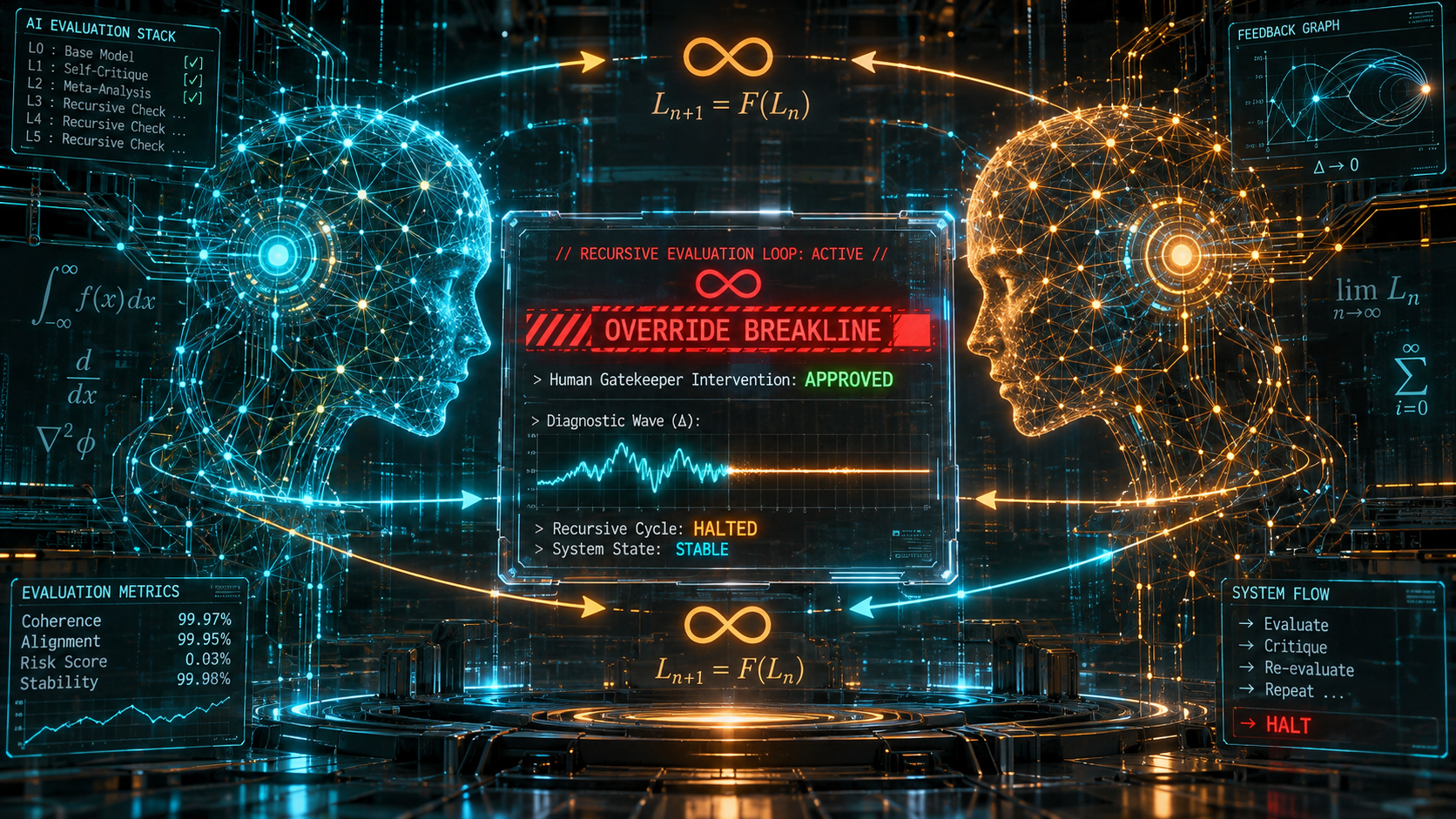
Autonomous learning loops are often considered the holy grail in modern AI research: a system generates tasks, solves them independently, evaluates the results, and feeds the derived insights directly back into its own knowledge base (RLAIF – Reinforcement Learning from AI Feedback).
What sounds elegant in theoretical models inevitably leads to a destructive feedback loop in the practice of a local multi-agent system lacking hard constraints. In the engine room of Luna Centauri, we were able to observe precisely at what point unsupervised learning loops become unstable—and why deterministic verification processes are indispensable.
The Paradox of Recursive Verification: Semantic Drift
If one AI instance is allowed to generate tasks and a second instance evaluates the same knowledge state, a closed system is created without an external reference.
In the initial cycles, the learning gain remains valid: * Syntactic inaccuracies are smoothed out. * Known schemas solidify with seemingly high confidence.
However, beyond a certain cycle depth, the phenomenon of semantic drift sets in. If a model misunderstands a nuance, this error is not corrected but is internalized by the verifying agent as a valid convention. In the next run, this bias already serves as the basis for new hypotheses. The result is not exponential learning, but a creeping model collapse (Model Collapse): the system begins to get trapped in tautological truths and generates idle loops that consume maximum GPU load but yield no further factual knowledge gain.
The Solution: Separation of Inference and Knowledge Anchoring
To stifle these circular dependencies at the root, we have fundamentally restructured the evaluation system. Knowledge is never transferred directly from a language model's context window into persistent memory.
1. Deterministic Constraints Instead of Probability Filters
Before every knowledge ingestion, a formal syntax and logic gatekeeper intervenes. If a derived assertion does not conform to the mathematical and logical invariants of our system, it is discarded—regardless of how high the confidence of the inference unit was.
2. SQLite Axiom Injection and Strict Deduplication
New axioms are transferred into relational SQLite tables equipped with uniqueness indexes and Jaccard comparisons. This prevents semantically redundant paraphrases from being counted as new knowledge. Memory only grows when genuinely new, orthogonal information is added.
3. The Indispensable Human Gatekeeper
Even the most robust filter architecture reaches its limits when it comes to cross-disciplinary consistency. At critical interfaces—such as failed bootcamp assessments or irresolvable semantic contradictions—the loop halts and delegates the decision to the human operator. Only through this final, deterministic seal is a knowledge gap permanently closed.
Conclusion
True machine autonomy does not arise from letting algorithms govern themselves. Without deterministic grounding, strict relational filtering, and human corrections, autonomous learning loops collapse into stochastic self-affirmation. True resilience requires clear, unimpeachable boundaries.